


The global economic model that powered India’s rise after the 1990s is reaching its structural limits. The services-led growth pathway anchored in IT exports, white-collar outsourcing, global mobility of talent, and liberal capital flows was a product of a very specific moment in history. That moment is fading as Artificial intelligence is rapidly automating cognitive and clerical work that once provided India with comparative advantage. Immigration walls are rising across the United States and Europe, restricting the movement of people. Technology transfers are increasingly securitised, weaponised, and filtered through national security lenses. Capital is no longer frictionless. In this emerging environment, the old playbook cannot deliver the next phase of India’s growth.
At the same time, agriculture remains a stagnant and structurally unrewarding sector. It employs a disproportionate share of India’s workforce while contributing a declining share of GDP. Productivity growth is limited, income growth is uneven, and the sector cannot absorb India’s demographic pressures. If India is to generate mass employment, raise per capita incomes, and move decisively up the value chain, it must expand manufacturing and industry as a percentage of GDP. There is no viable alternative. Industrialisation is not a choice it is an economic necessity.
Manufacturing, however, does not thrive in isolation. It requires access to large, high-income consumer markets, deep capital pools, advanced technology, and stable demand. For India, only two markets meet these criteria at scale: the United States and Europe. China is no longer a complementary market or a benign partner in this domain; it is rather a peer competitor for these markets. Chinese manufacturing dominance across electronics, machinery, chemicals, and intermediate goods has saturated global markets. India’s challenge is not simply to manufacture, but to manufacture competitively and at scale within global supply chains that are now being restructured.
The recent trade agreements and negotiated tariff frameworks have therefore created a rare and strategically significant opening for India. By securing an effective tariff advantage in trade agreement with USA i.e. roughly 18 percent versus China’s 37 percent India has altered the cost calculus for multinational firms looking to diversify or relocate production. In a world of razor-thin margins, such differences are decisive. They influence where factories are built, where capital flows, where technology is transferred, and where jobs are created. This is not symbolic diplomacy or ideological alignment; it is hard economics.
Russia, by contrast, does not offer comparable market depth. While it remains a critical strategic ally and an indispensable partner in energy security and defence, its domestic consumption market is limited. India’s trade relationship with Russia must therefore evolve beyond hydrocarbons and arms into areas such as minerals, fertilizers, logistics, industrial inputs, and financial cooperation. But this reality does not alter a central truth that sustained access to Western markets, capital, and technology is essential for India’s long-term economic trajectory. The world of the 1970s and 1980s defined by protectionism, import substitution, and ideological non-alignment is gone.
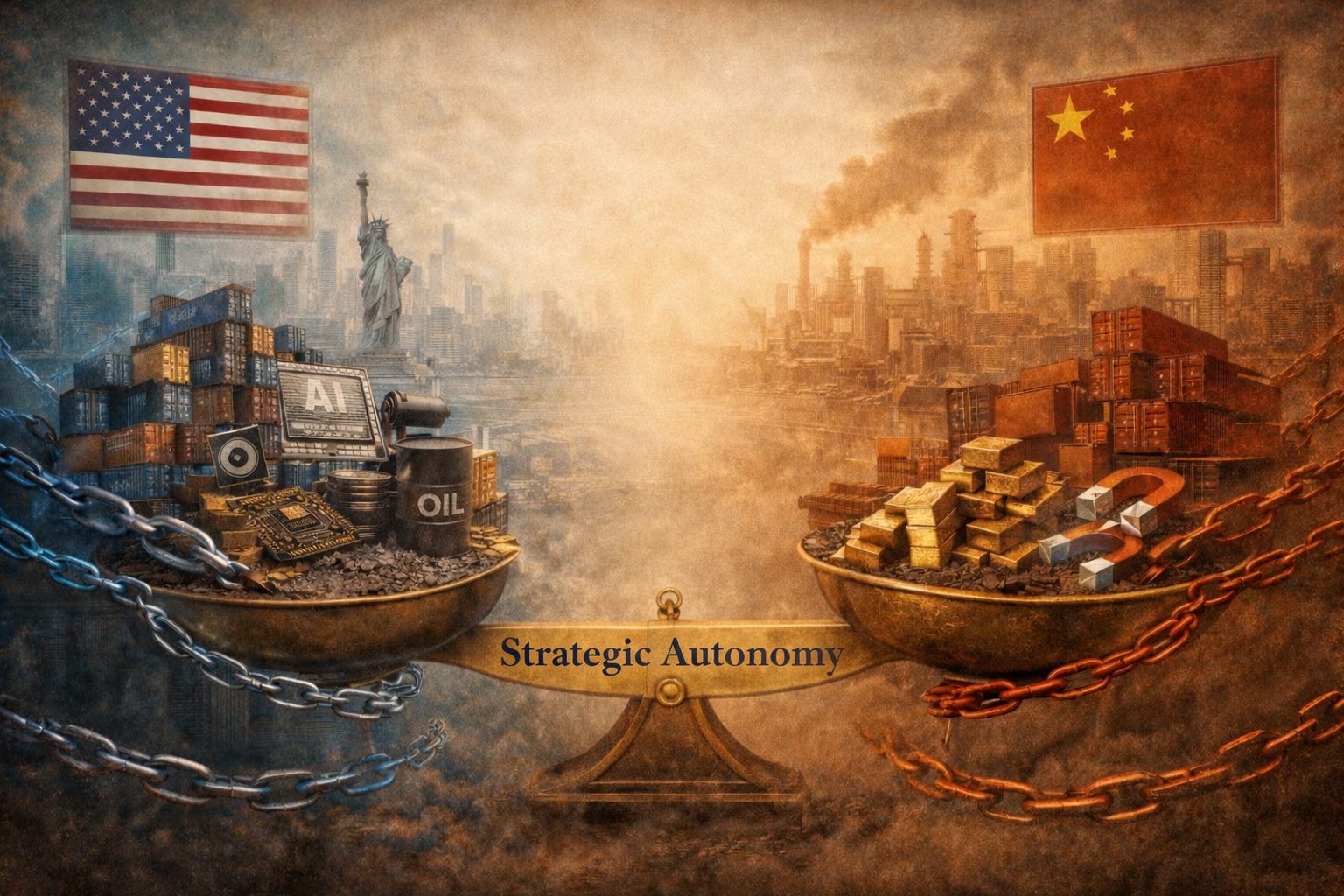
This is where the concept of strategic autonomy must be carefully examined. Strategic autonomy is often presented as an absolute ideal, but in practice it has always been relative. States operate within constraints economic, technological, demographic, and geopolitical. The primary obligation of the Indian state is not to abstract doctrines or historical nostalgia, but to the material well-being of its people. Jobs, incomes, competitiveness, and economic resilience must take precedence over rigid alignment theories.
India’s trade agreements with the United States, the United Kingdom, and the European Union must be understood in this context. Zero-duty or preferential access in critical sectors such as electronics, pharmaceuticals, and advanced manufacturing is not merely about exports; it is about embedding India into high-value Western supply chains. The strategic objective is clear i.e. to replace China in selected nodes of global manufacturing without triggering direct confrontation. This is why India has been encouraged to participate in emerging industrial frameworks such as Pax Silica. These are not military alliances, but supply-chain architectures designed to secure semiconductors, advanced materials, and industrial resilience.
Simultaneously, the global economy is undergoing a structural bifurcation. Two supply chains and two systems are emerging. China is actively constructing parallel financial and trade architectures to insulate itself from Western sanctions and coercive leverage. It is reducing exposure to US Treasuries, increasing gold reserves, promoting alternative payment mechanisms, and expanding bilateral trade in non-dollar currencies. This is not ideological defiance; it is strategic hedging born from experience.
The United States, for its part, is responding through a combination of financial innovation and coercive tools. Stablecoins, sanctions enforcement, export controls, and chokepoint strategies are being deployed to slow China’s technological ascent and preserve Western dominance in critical technologies. From pressure on Iran and Venezuela to supply-chain controls in semiconductors and advanced machinery, the objective is clear that is to delay China’s eventual rise and buy time for re-industrialisation in allied economies.
Yet even China operates within limits. Beijing has repeatedly demonstrated that strategic autonomy has boundaries. It reopened rare-earth exports to the United States and Japan when faced with escalating pressure. It resumed large-scale purchases of US soybeans to stabilise trade relations and preserve access to American capital and technology. Chinese firms, despite rhetorical tensions, faced being forcibly nationalised abroad like Nxperia or even being delisted from Western exchanges starving them of critical capital they seek to access in Western markets. At the Busan meeting with President Trump in 2025, even President Xi Jinping of China accepted the logic of managed competition over outright confrontation. This was not weakness; it was realism as Xi Jinping understood that it cannot let go of 35% of the market for Chinese goods in USA and European Union.
India faces similar structural constraints. Despite diversification efforts, Indian manufacturing remains dependent on China for APIs, machinery, raw materials, and critical components such as auto magnets. These dependencies cannot be wished away overnight despite many PLI schemes being launched to de-risk supply chains from China. China’s export control and licensing measures over rare earths in November 2025 highlighted that there are limits even for America when it comes to dealing with China making President Donald Trump roll back 100% tariffs threat. President Trump even took back threat of 100% tariffs on Greenland issue once the Europeans threatened to dump US treasuries and assets. Strategic autonomy does not mean eliminating dependence; it means managing it, mitigating risks, and avoiding catastrophic vulnerability. Even advanced economies operate within such frameworks and limitations.
Russia’s recent signals underscore this reality. Moscow’s indication that it may disengage from Iran’s Bushehr nuclear project amid credible US-Israeli threats to topple regime in Tehran illustrates the limits of defiance. China has been unable to rescue Maduro in Venezuela or protect its Oil interests, Russia on other side had to ultimately leave Syria or contemplate evacuating from Iran amid impending threat of strikes and regime change from America & Israel. Even major powers recalibrate when costs escalate beyond acceptable thresholds.
In this light, India’s potential disengagement from projects such as Chabahar Port in Iran should not be read as abandonment or surrender, but as strategic recalibration. Thus a certain diversification away from Russian oil to USA or Venezuelan oil, to save Indian manufacturing sectors and exporters, trade surplus, forex revenues from punitive tariffs does not belittle India’s strategic autonomy or sovereignty as critics are arguing, rather it secures and preserves India’s economic interests.
Strategic Autonomy and use of hard power is limited in real world dynamics, America could easily topple Saddam & Gaddafi decade back when they suggested selling Oil in Euro or Gold backed currency, but it is proving difficult to topple the regime in Tehran or stop China and Russia from building alternatives to Dollar trading system. There are limits to American power & coercive diplomacy as well as we are seeing in Ukraine where Russia has refused to accept Trump’s terms of peace that fail to address Russia’s genuine demands. Despite all pulls & pressure the BRICS+ countries continue to work and de-risk themselves from an unpredictable America by promoting bi-lateral trade settlement in non dollar terms. Even US allies like Canada, France and in Europe Union want to trade with India & China hedging the United States.
Thus the Government of India’s current strategy reflects this understanding. By pursuing trade agreements with US, EU, UK, NZ and prospective ones with GCC, Canada, Brazil and Eurasian Economic Union, India aims to diversify and restore export competitiveness while opening new markets for its labour intensive manufacturing & export sectors. India is prioritising employment, industrial growth, and economic resilience. Labour-intensive sectors textiles, electronics assembly, pharmaceuticals, auto components, garments, gems & jewellery, shrimps & fisheries employing millions stand to gain significantly. These are not abstract macroeconomic benefits; they translate directly into jobs and income growth.
Crucially, India has not pursued this strategy in isolation or submission. It has hedged intelligently. Defence and economic partnerships with Russia continue to expand. Strategic ties with France and Europe have deepened. Engagement with China continues through border de-escalation mechanisms and expanding bilateral trade. Within BRICS+, India is actively exploring non-dollar trade arrangements and incremental diversification toward gold reserves from US treasuries. These are not contradictions; they are layers of insurance.
Strategic autonomy in this environment is not about standing equidistant from all powers at all times. It is about maximising room for manoeuvre while minimising economic and security risks. Middle powers like India will inevitably face pressure as supply chains bifurcate and great powers compete. This is not the binary Cold War of the twentieth century where it will be easy to choose a side. Cold War 2.0 is happening where the global supply chains are interlinked, transactional, and economic at its core.
The Western strategic recalibration particularly within the Trump administration reflects a growing recognition that decoupling from China cannot be achieved unilaterally and working with Allies and partners are essential for achieving this objective. India’s scale, labour force, and political stability make it indispensable to this effort. This gives New Delhi leverage, not subordination and which it must use to the benefit of its people. India must understand that it should not miss the bus of manufacturing and rapid industrialisation in Industrial Revolution 4.0 (IR 4.0) with an AI & Data Center, Power & Energy and Infrastructure boom that beckons it.
The cardinal mistake made in early 90s must not be repeated where India pivoted towards services sector leaving China to become the global manufacturing hub of the world. India needs to create more Apple like examples, deregulate and make it a central node for Hyperscale economy in GCCs and Manufacturing in electronics, pharmaceuticals, semiconductors and allied goods in IR 4.0. Thus pragmatism should override any ideological, theoretical abstract notions which looks good in academic debates but realities in real world are far away from theories & absolutism of debates.
Ultimately, the debate over strategic autonomy must move beyond slogans. Absolute autonomy is a myth in an interconnected world. What matters is outcome-driven autonomy i.e. the ability to secure growth, protect national interests, and preserve decision-making flexibility. The Government of India’s trade strategy reflects a sober assessment of global realities. It is not about choosing sides; it is about choosing outcomes that serve India’s people, economy, and long-term resilience in an increasingly fragmented world order.
As the rules based world order collapses, India must pivot itself to be be the central node in creating a multi-polar world order amid emerging Bi-polarity working with like minded powers in GCC, Russia and the global south but that will not mean isolating itself or losing out on the opportunities that comes its way from the Western world. India just like UAE could become a melting pot and meeting point for the supply chains to interact with each other. The future is bright for those who are willing to play and take the risks and India must do so keeping solely its national interests in mind i.e. India First.