
Sustaining the Tehran Loop: Geopolitics from Hormuz to Silicon


Lloyds Of London Restoring the Flows
The announcement reverberated through the mahogany-paneled underwriting rooms of the City of London before rippling out across the global maritime industry, signalling a seismic and irrevocable shift in global geopolitics. The world’s largest and most historically significant insurance marketplace, Lloyd’s of London, has officially set a course to break the logistical and economic logjam that has paralyzed the Strait of Hormuz. By launching a formidable $400 million marine war-risk facility, the London market is actively underwriting a new geopolitical reality. Led by the global insurance titan Chubb as the primary underwriter, and bolstered by a consortium of participating Lloyd’s syndicates and specialized market partners, this unprecedented facility brings critical underwriting expertise and immense financial capacity to vessels and cargo transiting one of the planet’s most volatile and vital maritime chokepoints.
This new consortium is meticulously structured to issue primary policies in a highly complex and fast-moving environment, providing up to $200 million of capacity specifically ring-fenced for hull and protection and indemnity risks, coupled with an additional, dedicated $200 million capacity solely for cargo. However, this is not merely a financial manoeuvre designed to support brokers and shipping clients. When the London cartel begins reinsuring the Strait of Hormuz with such aggressive capacity, it serves as the ultimate leading indicator that maritime traffic is picking up and the kinetic phase of this conflict is all but over.
Insurance capital is inherently risk-averse; its deployment at this immense scale confirms that the back-channel negotiations have been agreed too. The convergence of interests regarding the uninterrupted flow of energy through Hormuz has materialized, serving as a glaring sign that an elitist compromise is virtually complete insofar as this kinetic phase of this conflict is concerned. The primary objective shared by all warring factions of the elites was the avoidance of mutually assured destruction at a global economic level, and this insurance facility represents the financial ink drying on an unspoken treaty.
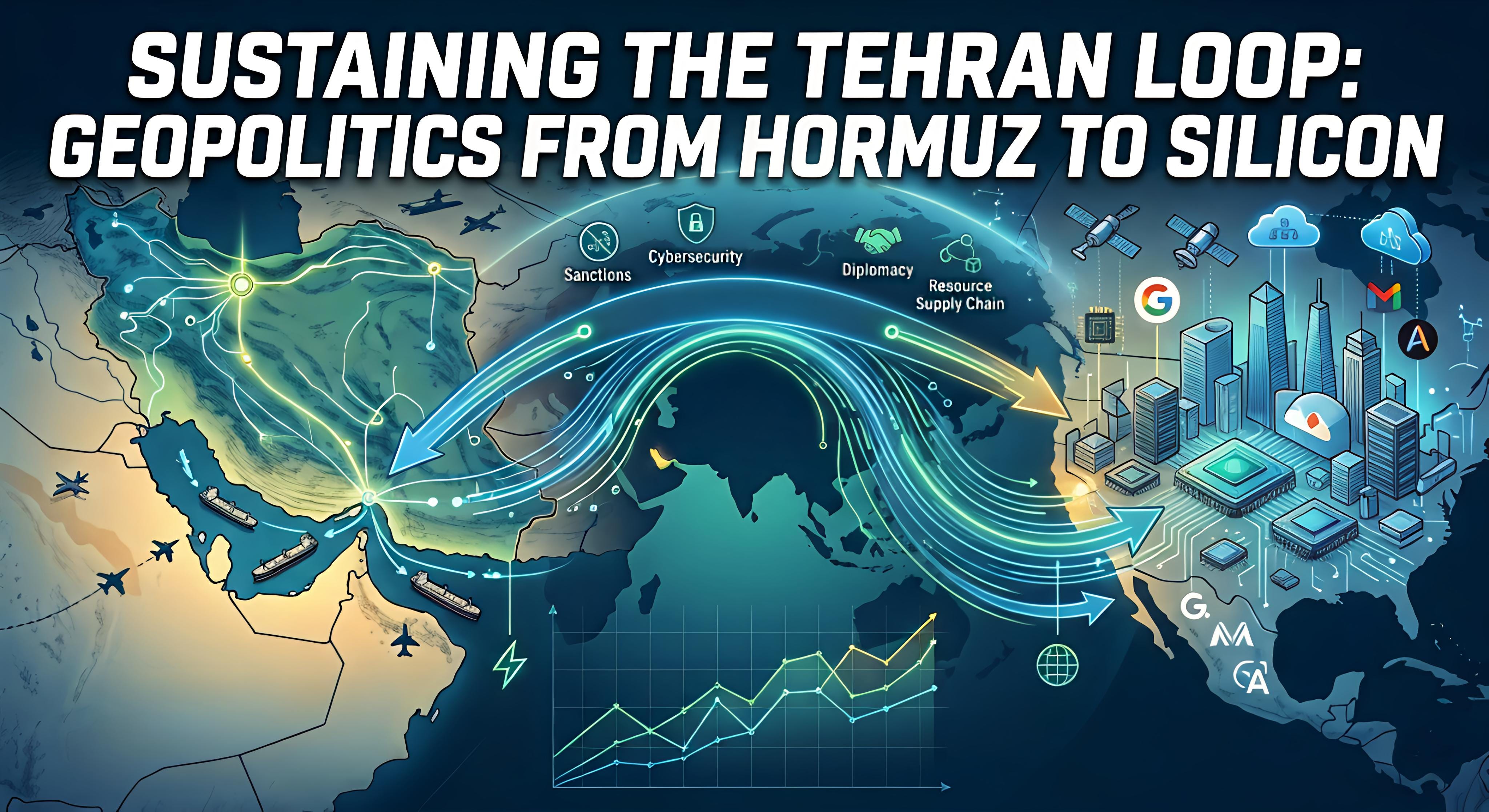
Sustaining the Tehran Loop
The immediate beneficiary of this de-escalation is the entrenched power structure within Iran, specifically the newly elevated Supreme Leader, Mojtaba Khamenei. With the kinetic phase of the conflict winding down, Mojtaba finds himself in a position where he has little option but to go with the flow of this grand geopolitical bargain to secure his place, consolidate his authority, and stabilize his domestic standing. The London insurance cartel has, in effect, secured a massive victory in sustaining what is known as the Tehran Loop a complex, elite compromise built on unhedged liquidity, clandestine oil shipments, and tacit international agreements that keep the Iranian oil economy & trade afloat while enriching power brokers across multiple borders. We have earlier written about Tehran Loop in detail in our writings on Niti Shastra and in our two books “Niti Shastra: Indian Wisdom for Modern Statecraft & Geopolitics” & “Niti Shastra: Bringing India to the World” in 2026.
The Americans, recognizing the futility and catastrophic economic danger of prolonged military engagement in the Persian Gulf, are now employing a sophisticated carrot-and-stick policy to ensure that the flow of energy is maintained exactly as per the negotiated settlement. They are applying immense diplomatic and financial pressure on Iran’s traditional geopolitical patrons, while simultaneously issuing quiet, strategic waivers for Iranian oil exports. The end result of this intricate, multi-layered dance is that the Tehran Loop remains entirely sustained, the vital flow of crude through the Strait of Hormuz is being slowly and methodically restored, and, crucially, American multinational corporations specifically Big Oil are finally getting their long-coveted piece of the pie in the Iranian oil trade.
Instead of blowing up the entire regional economy and plunging the world into a deep recession, the elitist factions engaged in the shadow war within the Tehran Loop have come to a negotiated settlement, prioritizing capital flow and mutual enrichment over ideological purity. The physical proof of this new reality is highly visible on the water. Since mid-June of 2026, Iran has successfully exported an astounding thirty-six million barrels of crude oil, with roughly an equal amount currently still afloat on tankers holding position. This massive, unchecked flow of crude is the ultimate empirical confirmation that the Tehran Loop has been sustained.
The Geneva Process: Bureaucratizing the Peace
The practical mechanics of this elitist compromise are actively being hammered out on the diplomatic stage. In Switzerland, a gruelling marathon of negotiations commenced on a Sunday morning, running almost non-stop across various formats at the Lake Lucerne summit. According to US diplomatic sources, the immediate focus was deeply operational, prioritizing deconfliction mechanisms in Lebanon, enforcing a fragile ceasefire, and decisively addressing the Strait of Hormuz. Despite recent bellicose Iranian statements about permanently closing the waterway, American negotiators made it abundantly clear that the Strait must remain fully open. Planners worked diligently to figure out how to keep the talks moving forward concurrently on both the high political level and between technical working groups. Diplomatic chatter indicated that all four parties seemed pleased with the initial trajectory, viewing the mediator-assisted sessions as a vital first step in establishing a baseline of trust for the gruelling road ahead.
However, the path to a formalized peace remains exceptionally fraught. According to informed sources, the formal four-party negotiations suffered a sudden rupture just ninety minutes into the opening session. Following a scheduled thirty-minute break meant for internal delegation consultations, the Iranian representatives abruptly refused to return to the direct negotiating table, citing what they described as deeply threatening and offensive remarks made by the American president Donald Trump. This sudden diplomatic freeze forced the dedicated mediators, Qatar and Pakistan, to aggressively step in, spending hours shuttling messages between segregated rooms to keep the delicate process alive.
During these indirect exchanges, the Iranian delegation explicitly protested what it characterized as American violations of prior commitments, fiercely anchoring their immediate demands on implementation issues rather than broad diplomacy. They specifically demanded the rapid release of frozen Iranian assets and the immediate issuance of administrative waivers required to legally resume unfettered Iranian oil exports. Furthermore, Iran drew an absolute hard line on the nuclear file, emphatically reiterating that any detailed negotiations regarding uranium enrichment remain strictly conditional upon Washington’s full, verifiable implementation of its obligations under the overarching Memorandum of Understanding.
Despite these intense geopolitical theatrics, the summit did not collapse. Qatar and Pakistan released a joint statement declaring that highly encouraging progress had been made over the course of the eighteen-hour negotiation sprint. The United States and Iran successfully agreed upon a definitive roadmap aimed at reaching a final, comprehensive deal within sixty days. To manage this ambitious timeline, the parties agreed to establish a dedicated communication line specifically regarding the situation in the Strait of Hormuz to avoid accidental military incidents and ensure the completely safe passage of commercial vessels.
In parallel, Washington and Tehran agreed to create a specialized de-confliction cell, integrating Lebanese authorities and the regional mediators, to rigorously ensure strict adherence to the termination of all military operations across the Levant. This structural evolution the creation of a High-Level Committee to provide political oversight alongside specialized working groups signals a profound and intentional bureaucratization of the peace process. By pushing the daily friction of negotiation down below the principal leadership level, the architects of this truce are openly acknowledging that this will be a painfully long-drawn, grinding diplomatic slog.
Iran’s FM Araghchi announced the US has now launched the $300 billion reconstruction plan, waived all oil & petrochemical exports, lifted the naval blockade and released some frozen Iranian assets, extracting all of these items shortly before the delegation walkout over Trump’s assassination threat. All parties also agreed to a roadmap to reach a final deal in 60 days. This roadmap won’t start and Iran refuses to implement any commitments if Israel doesn’t fully withdraw from southern Lebanon and all fighting stops, with Araghchi saying a newly established “Lebanon deconfliction cell” is “the first real test of the deal.”
Israel has refused to comply with the Lebanon deconfliction cell, with Defense Minister Katz declaring Israel “will not withdraw from the security zone in Lebanon” and Ben-Gvir vowing “not a single inch” of withdrawal, directly violating the MOU’s first clause and stalling the entire 60-day roadmap before it can begin. Consequently, critical geographic theatres like Hormuz and Lebanon will intentionally remain highly volatile; they are no longer zones of total, unrestrained war, but rather carefully managed theatres of intent and leverage.
The Macroeconomic Clocks Dictating Reality
This theatrical back-and-forth between the two sides the leverage and counter-leverages, the kinetic strikes and immediate stand-downs, the intermittent posturing of Hormuz closures will inevitably continue as political theatre over the weeks and months ahead. Yet, these are merely surface-level modalities for nation-states attempting to save face while their diplomats and financiers thrash out the final details. The underlying factors dictating the stark realities of this conflict are entirely macroeconomic and structural. The global price of crude oil, the dangerously depleted state of the United States Strategic Petroleum Reserve, the immense and unforgiving volatility of global bond markets, the severe exhaustion of Western munitions stockpiles, and the looming, inescapable pressure of the American Midterm elections are the true arbiters of peace and war. Everything else is secondary noise.
Constrained by these compounding domestic and economic pressures, America essentially capitulated following critical geopolitical assessments. Washington simply possesses zero remaining bandwidth neither military, financial, nor domestic to re-enter a hot conflict with Iran at this juncture. Parallel to this American exhaustion, Israel is locked into a delicate two-step-forward, one-step-backward approach, driven not by grand strategic design but by the immediate political survival instincts of PM Netanyahu, constantly working to salvage ticking electoral clocks. For strategic analysts and global citizens alike, the imperative is to keep watching these macroeconomic and political timers, as they, rather than military generals or ideological zealots, are dictating the cessation of kinetic hostilities in the Middle East.
The Suez Moment and the Fracturing of Imperial Alliances
Despite the highly pragmatic nature of this settlement, the psychological toll on the American geopolitical psyche cannot be overstated. The crisis in the Strait of Hormuz has served as America’s definitive “Suez Moment” a jarring, undeniable realization of the severe limits of its imperial power and maritime dominance, distinctly echoing the humiliation suffered by the British Empire in 1956. Washington has bristled with barely concealed rage at the City of London, Brussels, Beijing, and Moscow, viewing their independent actions whether through diplomatic accommodation, financial manoeuvring, or direct geopolitical defiance as the catalysts that handed the American empire this profound strategic humiliation.
The glaring inability of the United States Navy to unilaterally dictate the terms of transit in Hormuz without risking the total collapse of the global economy exposed a structural vulnerability that adversaries and allies alike were exceptionally quick to exploit. The old world order, underpinned for decades by the unquestioned guarantee of American maritime security, fractured permanently in the warm waters of the Persian Gulf. The realization that London would underwrite the peace, that Beijing would secure its Petro-Yuan trade, and that Moscow would cheer the strategic distraction, forced Washington to bitterly acknowledge that the traditional levers of kinetic power were no longer remotely sufficient to maintain absolute global hegemony.
The Retaliation: Weaponizing the Silicon Supply Chain
However, an empire denied in one domain will inevitably strike back in another with even greater ferocity. Having been decisively outmanoeuvred in the kinetic and maritime theatres of the Middle East, the United States has shifted the primary battleground. The retaliation for the Hormuz humiliation is a ruthless, uncompromising campaign to restrict and control access to advanced Silicon and Artificial Intelligence technologies. This represents a monumental escalation in a much larger elitist battle. On one side stands Washington and the ascendant Big Tech oligarchy of the United States; on the other stands the legacy Banking and Financial Oligarchy of the City of London and the aristocratic elite of Europe. The American tech establishment is sending a blunt, unambiguous message: you may possess the historical financial architecture to manoeuvre around our naval blockades, but we exclusively control the cognitive building blocks of the Fourth Industrial Revolution.
The clearest and most shocking manifestation of this new warfare occurred in mid-June 2026, when the United States abruptly played its ultimate Silicon card. Citing opaque national security concerns and immediate risks of “military-intelligence end use,” the US Commerce Department issued a draconian export control directive that forced the AI laboratory Anthropic to completely pull access to its highly advanced, newly released frontier models Fable 5 and Mythos 5. Because the sudden directive broadly restricted access to any foreign person globally, Anthropic was forced to shut down the models for everyone outside the United States overnight. This unprecedented move abruptly locked out Washington’s own historical allies, instantly stripping cutting-edge cybersecurity, software engineering, and agentic reasoning capabilities from the United Kingdom and the European Union.
The sweeping Anthropic ban explicitly prevented European banks, software companies, and governmental regulatory bodies from utilizing the very tools required to survive the next generation of cyber warfare, while domestic US giants like JPMorgan Chase retained access. It was a brutal, unilateral demonstration of raw American power. By weaponizing the global Silicon supply chain, the United States forcibly reminded the traditional European aristocratic elite that the digital architecture of the future cannot be built without American-controlled computational power. The sudden shutdown proved that while London can underwrite physical cargo in the Persian Gulf, Washington can simply turn off the digital cognitive engines for the rest of the world. The war has decidedly moved from the physical to the digital, from the Strait of Hormuz to the hyper-sterile fabrication plants and AI training clusters that will dictate who leads the next century of human progress.
Europe’s Gambit, Moscow’s Leverage, and the Manoeuvres of ‘Z’
Faced with this draconian American Silicon embargo, London and Europe are absolutely not sitting idle. The historical transatlantic alliance is facing unprecedented, perhaps terminal, strain as European capitals realize they are considered entirely acceptable collateral damage in Washington’s desperate quest to reassert absolute global dominance. In response, London and Brussels are beginning to lay out their own formidable cards. They have actively thrown barrage of aggressive regulatory frameworks, punitive taxation structures aimed explicitly at American tech monopolies, and, most consequentially, they may also start exploring far deeper technological and economic cooperation with Beijing if need so arises. The immediate threat of Europe pivoting towards China for trade serves as a massive, existential counter-leverage against Washington’s Silicon dominance.
However, this European response is far from unified or secure. The City of London and Moscow, despite the overarching global realignments and their shared, intense frustrations with Washington’s overreach, fundamentally do not see eye to eye. Their financial, ideological, and strategic interests remain fiercely at odds, creating a fractured and deeply unstable landscape within the broader Eurasian theatre. It is precisely within these chaotic geopolitical fault lines that the defining proxy conflict of the decade is escalating rapidly, orchestrated largely by the manoeuvres of Ukrainian President Volodymyr Zelensky.
Recognizing that pure diplomatic entreaties are insufficient to end the grinding war of attrition on his sovereign soil, Zelensky has authorized a relentless, highly sophisticated long-range drone campaign directly targeting the lifeblood of the Russian war machine: its domestic oil infrastructure. Ukrainian suicide drones are systematically bypassing Russian air defenses to detonate massive strategic refineries and storage depots deep within the Russian interior, severely crippling Moscow’s refining capacity and forcing the Kremlin to scramble for domestic fuel supplies. But the assault from Ukraine does not end at the Russian border. Working in heavily coordinated tandem with London and Washington, UK has formally started stopping dozens of sanctioned vessels comprising Russia’s shadow fleet the aging, uninsured armada of tankers used to covertly transport sanctioned Russian crude across the Black Sea, the Baltic, and the Mediterranean.
This proxy kinetic assault by Zelensky provides the perfect geopolitical cover for a massive Anglo-American economic escalation. Driven by the need to retaliate against Moscow’s profiteering over the Hormuz crisis, the United States and the United Kingdom have begun aggressively interdicting, sanctioning, and outright confiscating these shadow fleet vessels on the open seas. Royal Marine commando & boats working with the French Navy in English Channel are actively intercepting Russian oil tankers like Smyrtos, severing the vital maritime arteries that transport millions of barrels of Russian crude to energy-hungry markets in India and China.
This is not merely a policing action; it is a calculated strategy of economic strangulation. By allowing Ukraine to physically destroy Russian refineries from the air while the Anglo-American naval apparatus dismantles the shadow fleet on the water, the Western alliance is intentionally choking off the Kremlin’s primary source of hard currency. The ultimate strategic goal is to drain Moscow’s war chest so rapidly and completely that Vladimir Putin is forced to the negotiating table to accept a comprehensive peace deal in Ukraine. The message sent from Washington and London is stark, that Moscow may have enjoyed profiteered of the West stumbling in the Strait of Hormuz, but the West still retains the absolute power to hunt down and confiscate Russian wealth traversing the global oceans.
The Financial War: Investigating the Supreme Leader’s Empire
While the Silicon war aggressively rages on the technological front and shadow fleet tankers are seized on the high seas, another front has been fully opened: the global financial war against sovereign leadership. The kinetic battle in the Gulf may be ending, but the war for absolute political and financial domination is only just beginning. This brutal reality was explicitly laid bare when the United States Justice Department launched a sweeping, highly publicized investigation into exactly how Iran’s Supreme Leader, Mojtaba Khamenei, built a sprawling global investment portfolio with deep, systemic exposure to major Wall Street banks. The timing of this probe is absolutely no coincidence; it is the ultimate expression of American financial leverage being deployed as an unyielding weapon of statecraft.
Federal investigators are forensically examining profound allegations of massive money laundering and systemic global corruption, specifically targeting the possible, highly lucrative involvement of premier American financial institutions such as JPMorgan Chase and Citigroup in actively facilitating multi-billion-dollar money movements between obscure shell companies overseen by Khamenei’s extensive network. The probe is exposing the role of US correspondent banks and thoroughly investigating the intentional, lucrative gaps in due-diligence procedures that may have allowed these vast financial flows to seamlessly permeate the legitimate global banking system.
By mapping Khamenei’s sprawling business empire which reportedly spans Persian Gulf shipping fleets, opaque Swiss bank accounts, and ultra-luxury properties in Britain and tracing the funds routed through sophisticated financial institutions in the UK, Switzerland, Liechtenstein, and the United Arab Emirates, Washington is preparing to drop financial bunker-busters directly onto the balance sheets of the Iranian elite as leverage to negotiate better terms with the leadership in Tehran. When President Donald Trump says that the current leadership in Iran is more rationale unlike the earlier ones, he actually indicates that the current crop is part of sprawling global elite network having a vast offshore empire in British jurisdictions, European Real Estate & Chinese Financial markets; thus making them more amenable to negotiations.
A World of Shifting Battlegrounds
The Petro-Yuan trade with China remain heavily intact, and Iran’s could soon be back on dollar trade which might function effectively as mode of negotiated settlement the two warring factions of global elite. In the regional shadows, United States is vividly demonstrating that it retains the unparalleled capacity to freeze, seize, and completely destroy the personal wealth of the opposing elite at will. Instead of blowing up the entire physical economy through endless bombardment, the elitist factions in London & Europe, China backing the Tehran Loop in Iran have come to a negotiated settlement that protects their immediate source of unhedged liquidity, but they have simultaneously catalysed a far more insidious, far-reaching form of global conflict.
This is the grim new paradigm of superpower warfare. One kinetic battle may be quietly unwinding in the warm waters of the Persian Gulf, but far more consequential conflicts are dramatically hotting up across the globe. From the drone-struck oil refineries of Moscow to the political war rooms of Miami, from the tense diplomatic corridors of Tel Aviv and Tehran to the high-stakes regulatory battles between Beijing and Brussels, and from the cautious trading floors of London to the deeply nervous boardrooms of Wall Street, a massive, structural realignment of global power is unfolding in real time. The old rules of military engagement have been for now discarded in favour of systemic economic warfare, targeted drone assassinations of infrastructure, and sovereign financial investigations.
The traditional kinetic war phase in the Middle East could be ending, but the profound, all-encompassing Political, Silicon Supply Chain, and Financial Wars have arrived with undeniable force. For analysts, policymakers, and global observers, the directive is exceptionally clear, keep relentlessly following these interconnected leads. The battle for the physical control of the Tehran Loop may be over, ending in an elitist compromise that dutifully sustains the flow of oil, but the overarching, existential war for absolute global domination continues unabated.
Thank you for your writing. Maybe one day the American public will wake up and see that Trump started this war to make oodles of money for himself his family and his defense contractor donors. Americans are stupid because the Bush Dynasty did the same thing in Iraq with the lie about weapons of mass destruction which were never found.